Online Course Revenue: Two Courses, Different Numbers, Similar Royalties
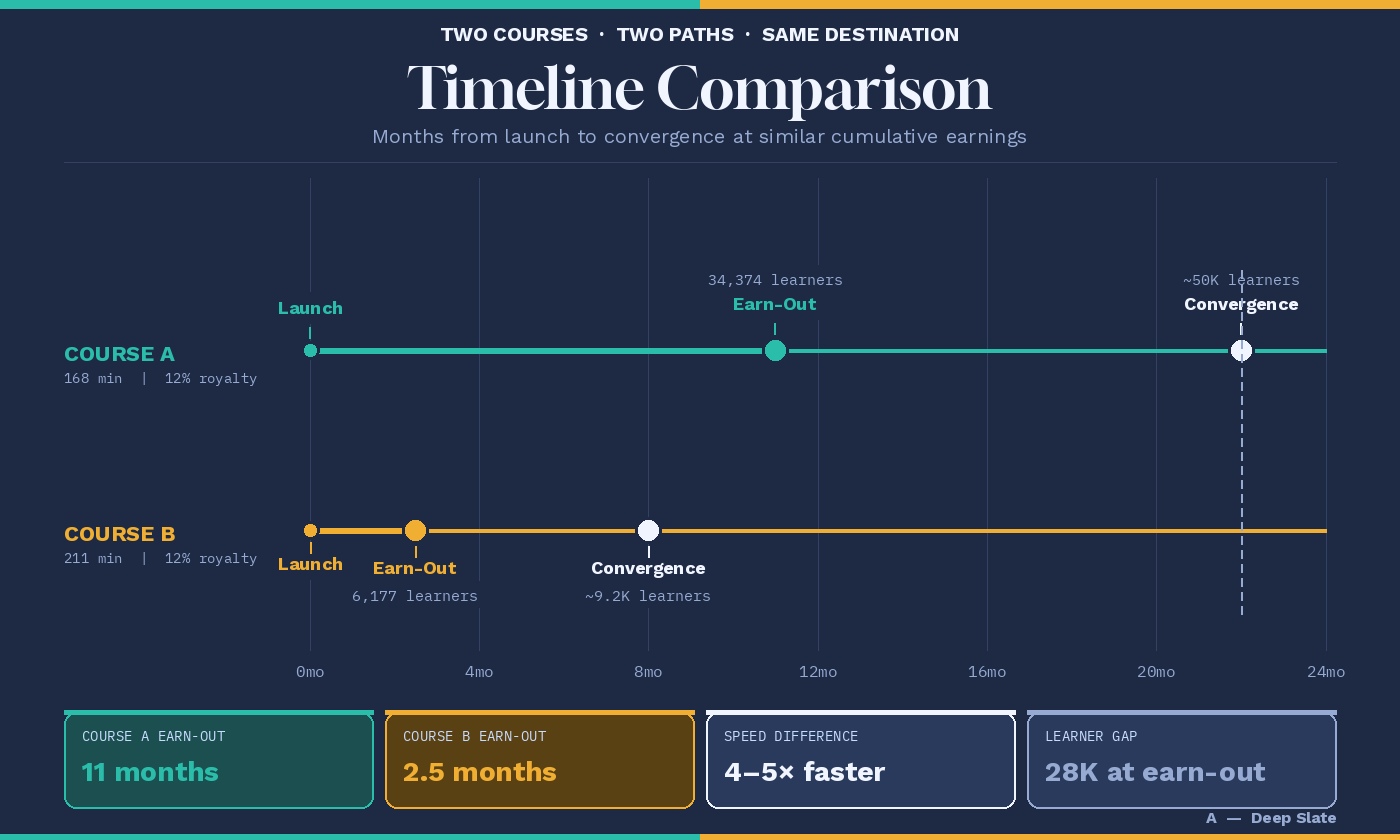
Two of my courses on LinkedIn Learning have reached roughly the same cumulative earnings, but one needed about 34,000 learners to earn out its advance, while the other needed just over 6,000.
There is almost no public data on how LinkedIn Learning royalties actually work. Most of what exists is speculation or secondhand. I am sharing real numbers from my own courses because this is the kind of information I wished I could find when I started.
A Bit of Context
I'm an online course creator with around 16 courses in Data Science, AI, and Healthcare Analytics on LinkedIn Learning (you can browse them at my courses page). One thing I'm constantly curious about is patterns in course performance, specifically how learner numbers translate (or do not translate) into earning potential.
This is tricky to map out because there are many variables: topic demand, timing, engagement levels, and platform specific parameters. None of this is fully predictable, and honestly, luck plays a real role.
Over the years I've accumulated a bit of my own data, and I thought it might be helpful to share some patterns.
A quick note upfront: I will not be sharing exact income figures. The goal here is to illustrate the shape of the pattern, not the absolute numbers.
How the LinkedIn Learning Royalty Model Works
LinkedIn Learning uses an advance against royalties model, which is common in traditional publishing.
In simplified terms:
- Creators receive an upfront advance tied to a royalty percentage.
- Royalties are calculated from a shared monthly revenue pool.
- The more paying subscribers watch your courses, the more you earn.
- Once your royalties exceed the advance, you begin receiving monthly payments.
It took about 23 months for me to earn out my very first advance, which meant royalties were something I read about long before I actually received them. That context matters when looking at the data below. (For more on earning out timelines across multiple courses, see my earlier post: How Long Until You Earn Out a Royalty Advance? Here's Some Real Data.)
Two Courses, Two Very Different Stories
Below is a comparison between two of my courses that have ended up at roughly similar cumulative earnings, despite very different trajectories.
| Metric | Course A | Course B |
|---|---|---|
| Course Length | 168 minutes | 211 minutes |
| Royalty Rate | 10-15% | 10-15% |
| Earn-Out Timeline | ~11 months | ~2.5 months |
| Learners at Earn-Out | 34,374 | 6,177 |
| Total Learner Count | ~50,000 | ~9,200 |
| Earnings vs. Advance | ~1.8x advance | ~1.5x advance |
| Time to Reach Similar Earnings | 22 months | 8 months |
The headline contrast: Course B earned out 5x faster with 6x fewer learners — yet both courses ended up at roughly the same cumulative earnings.
What the Numbers Reveal
1. Earn-Out Speed Is Not Just About Popularity
Course B earned out its advance roughly 4 to 5 times faster than Course A (2.5 months compared with about 11 months). But it reached that milestone with far fewer learners, about 6,000 compared with over 34,000. The difference likely comes down to earnings per learner. Topic timing, demand, and engagement quality can matter more than raw learner count when it comes to revenue velocity.
2. Large Numbers Do Not Always Mean Faster Revenue
Course A eventually accumulated close to 50,000 learners, far more than Course B. Yet it took 22 months to reach the same cumulative earnings that Course B achieved in about 8 months. This is a useful reminder that view counts and learner counts are not direct proxies for income. They matter, but they do not tell the whole story.
3. The Long Tail Matters
Both courses continue to generate royalties well after their launch periods. Course A in particular demonstrates something I see often. A course with a large and steadily growing learner base can become a slow but reliable compounding earner. That long tail can be surprisingly powerful over 18 to 24 months.
The Takeaway
If you are a course creator, or thinking about becoming one, here are the practical lessons I have taken from this:
- Numbers are social proof, but sustained engagement drives revenue.
- Earn-out speed reflects earnings quality, not just audience size.
- Topic relevance and timing strongly influence per learner value.
- Two courses with the same eventual earnings can follow completely different growth paths.
And both paths can work. None of this is guaranteed, of course. Many factors are outside your control, and luck is genuinely part of the equation. But what I have come to believe is that creating multiple courses does something important. It increases your luck surface area. Each new course is another entry point, another chance for timing and topic and audience to align. You cannot manufacture that alignment, but you can give it more chances to happen.
For me, this has been one of the most interesting aspects of creating online courses. The model rewards patience, consistency, and relevance over time. And sometimes, two very different roads lead to the same place.
If you are curious about the topics behind these courses or want to explore the full catalogue, visit wuraolaoyewusi.com.